The on-site special vehicle was a high-end police vehicle used in New Zealand, usually modified from large RVs. These came equipped with bedrooms, living rooms, kitchens, and bathrooms. Once connected to water and electricity, you could practically live in one.
After modification, an on-site vehicle typically included a lab or examination room with testing equipment to allow officers to process cases directly at the scene.
Of course, its biggest function was to provide a place for police officers to rest while on patrol—essentially a mobile police station.
“If we had a vehicle like that, it’d really show the strength of our town,” said Charlie.
Advertisement
Wang Bo nodded. “Sure, we could buy one. But if we’re really talking about showing strength, shouldn’t our police station have a helicopter too?”
New Zealand’s police force was well-equipped. Police stations in various cities had helicopters available, which could be called in during car chases, robberies, and other crimes for aerial support and coordinated arrests.
Charlie shrugged. “If you think it’s appropriate to keep a helicopter right now, go ahead.”
Truthfully, Wang Bo was tempted. But he knew he couldn’t be that reckless. The town was tiny—just riding a bike was enough for patrol. What would they need a helicopter for?
After deducting funds already allocated to roads, utilities, and community infrastructure, Wang Bo had less than 90 million NZD left. Building a town really burned through money fast.
Advertisement
First, they needed patrol cars. Hani advised against buying new ones—two used cars would do the trick.
The honest auditor gave him a heartfelt warning: “Mayor, I know you got a lot of money from selling your inheritance, but building a town takes even more money. Have you thought about what happens if you run out? Do you have any more inheritance lying around? Besides, don’t you Chinese say frugality is a virtue? Then why not be a bit more frugal?”
Wang Bo thought it over and realized he had a point. He already had a Marauder, a vehicle with a fierce and intimidating look that could serve as a police car. So he only needed to buy two regular cars—secondhand ones would be enough.
There were many ways to buy used cars in New Zealand: through dealerships, friend recommendations, TradeMe, or public bulletin boards in busy areas.
If you wanted convenience and were willing to pay, a dealership was the way to go—just tell them your requirements, and they’d find a matching car, inspect it, and handle any issues with paperwork or features.
But Wang Bo was trying to save money this time, so he didn’t want to go through a dealership. Hani was right—town building cost a lot. He couldn’t afford to be wasteful.
Buying through friends wasn’t ideal either. His New Zealand social circle consisted of upper-crust types—tycoons, regional heads of Christie’s, and so on. Who among them would be able to recommend a secondhand car?
And even if they could, their idea of “secondhand” probably cost more than a new car.
TradeMe was like New Zealand’s version of Taobao or Craigslist. You could freely buy and sell goods, find rentals, homes, or used cars.
Wang Bo turned to the internet. He got a few of his guys to help search for two good used vehicles to serve as patrol cars.
After a while, Bowen exclaimed, “Hey, guys, come take a look! What a beauty! Can’t believe there’s a car like this in New Zealand!”
Charlie and the others crowded around. Wang Bo, ever the boss, snatched Bowen’s phone directly. Juan quickly said, “Step aside, guys, let the boss look first.”
Arturo looked on with envy—if only he had that kind of bootlicking instinct, he thought, he’d be doing just fine.
Meanwhile, Juan was envious of Arturo’s physique. If he had a build like that, who’d need to flatter anyone? Just let your fists do the talking. His philosophy: don’t blabber—just act.
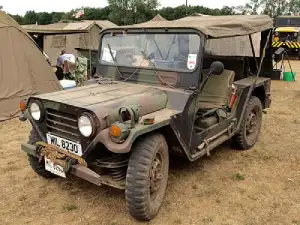
One glance and Wang Bo saw it was a military-green jeep on the screen, well maintained, looking just like the classic U.S. army jeeps from WWII movies.
According to the description, it was an M151E2 Jeep. He wasn’t mistaken—it was a U.S. military jeep, though more commonly used during the Vietnam War. The WWII model he remembered was the Willys Jeep, which this model later replaced.
The M151E2 earned widespread praise after release and was widely adopted by the U.S. military and many pro-American allied forces from the 1960s through the 1980s—until it was eventually replaced by the iconic Humvee.
This particular unit was from the last production batch in 1985, by which time the U.S. Army had already placed orders for the Humvee. These late M151E2 models were released for civilian use. One was bought by an American immigrant and brought to New Zealand.
That made the vehicle over 30 years old. While not quite a vintage classic, it definitely had a lot of aging or worn parts—it wouldn’t be easy to run.
The online listing priced the M151E2 Jeep at 22,000 NZD—a very reasonable price. But Wang Bo had doubts. “This car’s older than I am. Can it even be driven legally?”
Charlie reassured him, “No problem at all. Plenty of M151E2s are still running in Southeast Asia and Latin America—they were originally U.S. military aid vehicles. Many of those are even older than this one and still in use.”
Bowen nodded. “Jeep is the most rugged brand of all. My grandpa had a Willys, and my God, that thing still hasn’t retired—it’s working on my dad’s ranch right now.”
Wang Bo was intrigued. Just imagining himself roaring down the street in a U.S. military jeep—didn’t that scream “world police”? The very thought was thrilling!
He asked Hani whether this kind of vehicle could be used for police patrols. Hani said a jeep was fine, though no one in New Zealand had ever used this particular type of military jeep for police work—so he wasn’t sure.
That just made Wang Bo even more determined. He had to buy this car!
He called the seller, who said the jeep was in Christchurch. If they were interested, they could come check it out in person.
Wang Bo took Charlie, Bowen, and Juan and hit the road. Because it was winter, the roads were slick with condensation, so they drove slowly and didn’t reach Christchurch—one of the South Island’s four major cities—until late afternoon.
They had already made an appointment, and the owner came to meet them personally—driving the jeep, which appeared to be in good shape performance-wise.
Once they met, the man introduced himself as Harris, a pastry chef in Christchurch. The jeep had been brought over by his father when he was young and was treated as a family treasure. But now that his father had passed, Harris wanted to sell it to fund a dessert shop of his own.
Wang Bo inspected the vehicle.
Its design was rough and rugged. The paint was new and decent-looking. But what puzzled him was a strange steel rod at the front—about one and a half meters long, standing vertically from the center of the front bumper. It seemed like it would block the driver’s view.
M151E2 Jeep
Discussion
Comments
0 comments so far.
Sign in to join the conversation and keep your activity tied to this account.
ID used to identify users for 24 hours after last activity
24 hours
_gat
Used to monitor number of Google Analytics server requests when using Google Tag Manager
1 minute
__utmv
Contains custom information set by the web developer via the _setCustomVar method in Google Analytics. This cookie is updated every time new data is sent to the Google Analytics server.
2 years after last activity
__utmx
Used to determine whether a user is included in an A / B or Multivariate test.
18 months
_ga
ID used to identify users
2 years
_gali
Used by Google Analytics to determine which links on a page are being clicked
30 seconds
__utmb
Used to distinguish new sessions and visits. This cookie is set when the GA.js javascript library is loaded and there is no existing __utmb cookie. The cookie is updated every time data is sent to the Google Analytics server.
30 minutes after last activity
__utmc
Used only with old Urchin versions of Google Analytics and not with GA.js. Was used to distinguish between new sessions and visits at the end of a session.
End of session (browser)
__utmz
Contains information about the traffic source or campaign that directed user to the website. The cookie is set when the GA.js javascript is loaded and updated when data is sent to the Google Anaytics server
6 months after last activity
_gac_
Contains information related to marketing campaigns of the user. These are shared with Google AdWords / Google Ads when the Google Ads and Google Analytics accounts are linked together.
90 days
__utma
ID used to identify users and sessions
2 years after last activity
__utmt
Used to monitor number of Google Analytics server requests
10 minutes
Clarity is a web analytics service that tracks and reports website traffic.


Discussion
Comments
0 comments so far.
Sign in to join the conversation and keep your activity tied to this account.
No comments yet. Start the conversation.